


Are you tired of trying to rank for highly competitive keywords like your competitors?
I have two and a half words that will help you solve this problem:
Long-tail Keywords.
Why should you care about long-tail keywords?
Because they can drive tons of high-converting traffic to your website and significantly increase revenue for your business.
Take a look at how the free traffic flowing into the Ahrefs blog is skyrocketing this year?
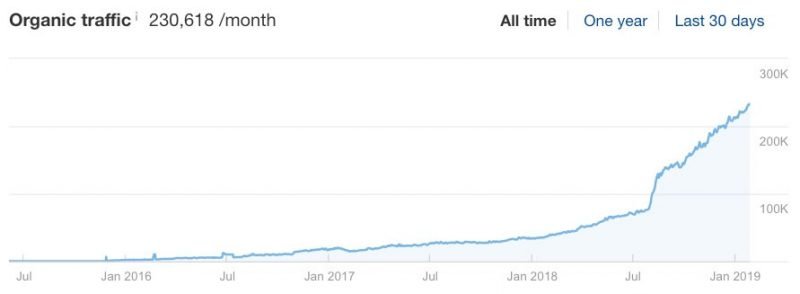
Organic traffic to the Ahrefs blog, via Ahrefs’ Site Explorer report.
This happened because we have been actively using keyword research strategies that I’m about to share with you.
In this guide, I’ll explain how to leverage long-tail keywords to get TONS of search traffic with the least amount of effort possible.
But first, let me share some interesting data to help you better understand what long-tail keywords are and why they’re so important.
What is a long-tail keyword?
Long-tail keywords are uncommon (i.e., low volume) and highly focused search queries that tend to convert exceptionally well when ranked highly.
Why are they called long-tail keywords? We’ll understand that in a second.
For now, you should know that the vast majority of Google searches are very specific and not popular (i.e., long-tail).
We analyzed ~1.9 BILLION keywords in the Ahrefs US database and found that 92.42% of them receive ten searches per month or fewer.
Monthly search volume analysis report from 1.9 billion queries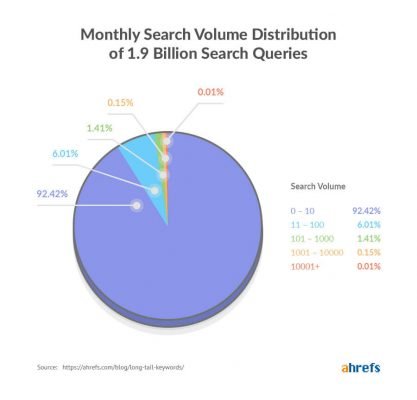
Let us “introduce” this pie chart on a more simplified scatter chart.
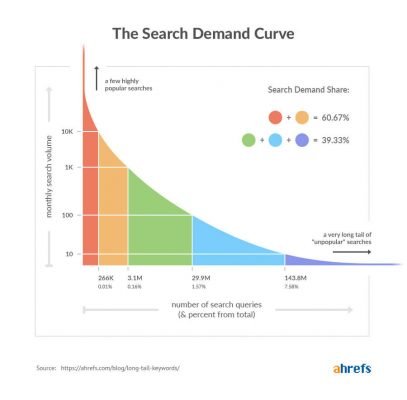
Now can you see why less popular keywords are called long-tail keywords?
Because they typically form a fairly longggggg tail displayed on the report chart.
Here’s an interesting fact about long-tail keywords
There’s a fairly common misconception in the SEO world that shorter search queries have higher search volume than longer queries.
Below, an example of this myth:
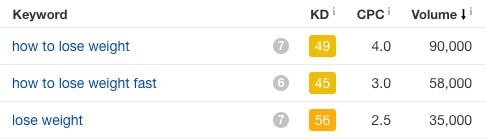
You can see that phrases with four and five words have significantly more search volume than the phrase with just two words “weight loss.”
Is this just a one-time phenomenon? Not at all.
From the same study of 1.9 BILLION keywords, we discovered that 29.13% of keywords with 10,001+ monthly searches are made up of THREE WORDS or more.
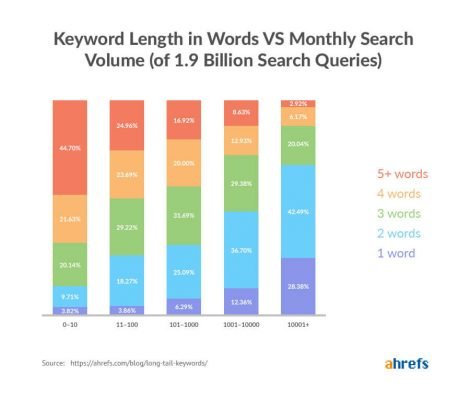
Below are some examples of long-tail keywords with high monthly search volume:
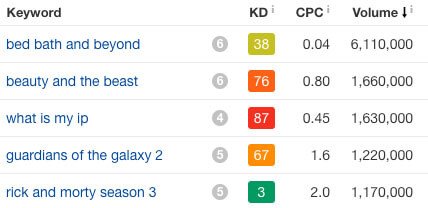
Additionally, 13.53% of keywords with ten searches per month or fewer contain only one or two words.
Below are some examples of short keywords that “lose out” compared to long-tail keywords on the search demand chart:

Key takeaway: You cannot (and should not try to) determine keyword popularity by looking at the number of words in the query. Short search queries can be part of the “long-tail” and long queries can be “head” keywords.
In other words, pay careful attention to your biases about keywords and don’t judge keyword popularity by word length.
How to find long-tail keywords
That was some interesting data to impress your SEO friends.
But now you might be wondering how to find long-tail keywords.
Well, one of the easiest ways is to take a broad topic and start typing it into Google’s search bar. Then you’ll see Google’s autocomplete suggestions, like this:

These will be more specific and less popular searches that may relate to the general topic you’re searching for.
You can also check more details in Google’s “People also ask” box.
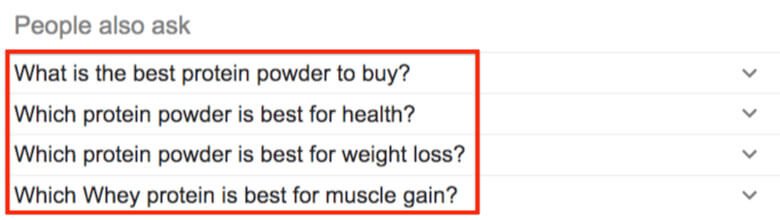
…. remember to also check the “Searches related to” section at the bottom of the search results.

These provide insight into other, less popular (but more specific) searches that people are making around that topic.
However, manually collecting these keywords from Google can be quite time-consuming. So you may want to use a professional keyword research tool to help you find thousands of long-tail keywords effortlessly in just seconds.
Log into Ahrefs Keyword Explorer.
Just enter the keyword you want to find, click on a report from the left menu, then use the Volume filter to find keywords with search volume that you consider low in the market you’re targeting.
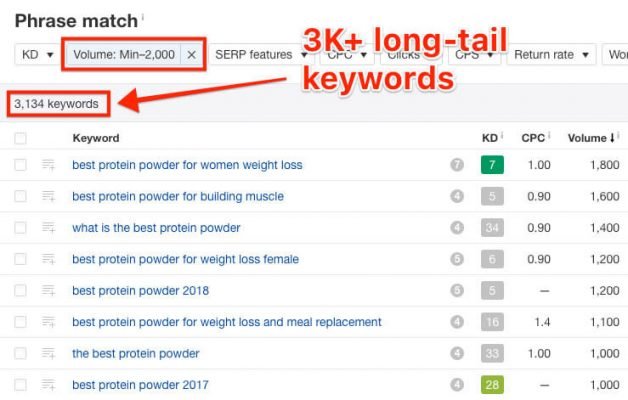
If you want to find more specific queries compared to general ones, you can also use the word count filter to find long-tail keywords that include more words.

Another tip is to use the “Question” report in Ahrefs Keywords Explorer. These types of queries are very likely to be the “uncommon and specific” kind (meaning long-tail queries).
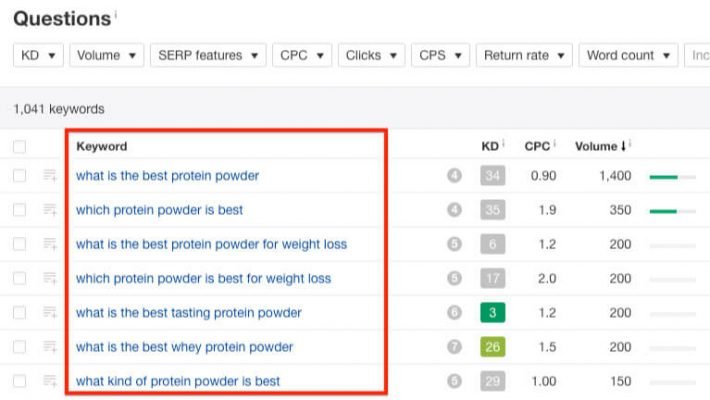
If you’re looking for another interesting free tool with similar functionality, try Answer the Public.

Another great way to discover excellent long-tail keywords in your field/industry is to browse the keywords that your competitors are currently ranking for.
You can easily do this with Ahrefs.
Enter a competitor’s domain into Ahrefs Site Explorer, go to the “Organic keywords” report, then filter for keywords with low search volume.
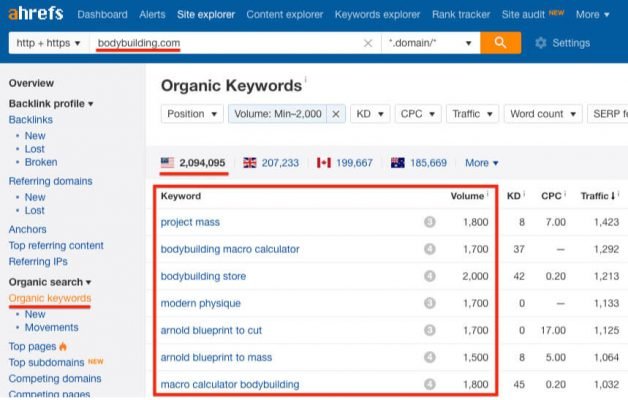
This can be a great way to find long-tail keywords in your niche that you may not have considered.
Below are a few other methods to find things that people in your industry may be searching for on Google:
- Understand your customer’s mindset: Think about how your customers might search for the products or services you offer. What language would they use? How would they phrase their searches?
- Communicate with your customers: Trust me, there’s no better alternative method to find out what words, phrases, and language your customers use.
- Look at topics in online communities: Check industry forums to see what questions your customers are asking and how they phrase them. You can also check Facebook groups and other social media platforms.
How to get TONS of search traffic from long-tail keywords
Long-tail keywords tend to be easier to rank for than head keywords.
For example, look at the top-ranking pages for the long-tail keyword “turmeric weight loss” (this query gets 2,500 monthly searches):

Here, most top-ranking pages have fewer than 20 referring domains.
Translation: If you created a page about this topic and built some backlinks to it, you could expect to rank in the top 10 fairly easily.
Now, let’s compare this with a popular term like “weight loss” (this keyword has about 98,000 monthly searches):

This time, all top-ranking pages have tons of backlinks. Your chances of outranking them are very low.
So, as a general rule, it will be easier to rank and get traffic with long-tail keywords.
Let me confuse you for a few seconds.
For the keyword “easiest way to lose weight,” which has 3,000 monthly searches, equivalent to “turmeric weight loss.” Does that mean this keyword is also easy to rank for with its low popularity?
Let’s look at the information from the top-ranking pages:

Oh my. It seems like these keywords are fiercely competitive. But why?
It’s all because this search query doesn’t comprise a unique topic of its own. It belongs to the broader topic of weight loss.
Let me explain.
When different people search for things like this:
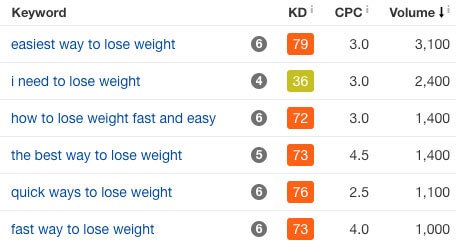
They’re all searching for the same thing.
Google understands this and ranks a nearly identical set of pages for all those long-tail keywords.
NOTE
We validated this specific example by checking the Traffic share by pages report in Ahrefs Keywords Explorer to see which page gets the most traffic from the list of search queries above.
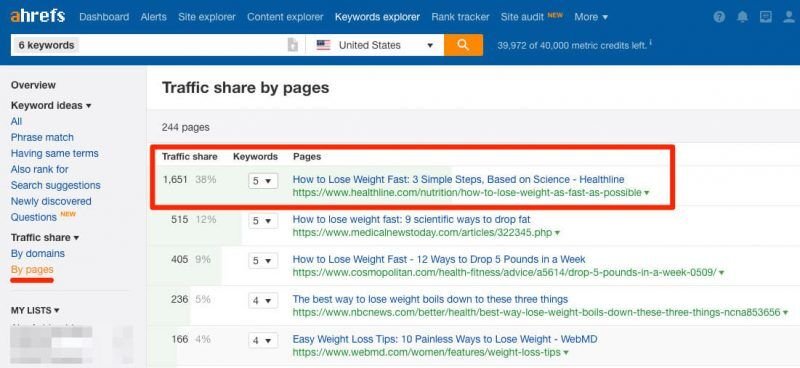
The top result (from Healthline.com) not only receives the most significant traffic share but also ranks for five of the six keywords we checked.
Then, we also checked the Organic Traffic report for this page in Ahrefs Site Explorer, and we could see that it ranks in the top 5 for over 8,000 RELATED keywords.
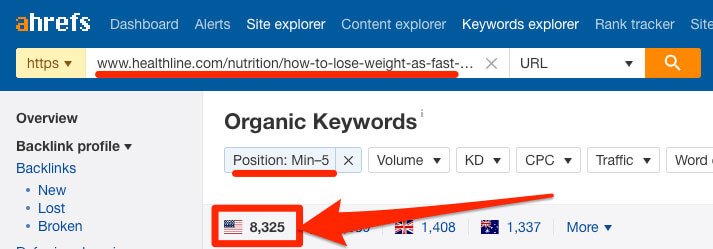
This proves that this topic is very broad and includes many long-tail keywords.
This brings us to an important point:
Each topic has its own search demand curve.
Here’s what the demand chart for the topic “weight loss” looks like:

You can see that while there are a few “head” terms, there’s a very long tail comprising thousands of low-volume keywords. All of those are part of the same overarching topic.
But this isn’t the case for all low-volume keywords.
Some long-tail keywords are topics in their own right, like “turmeric weight loss.”

Let us call them “topical long-tail keywords,” for lack of a better name.
Now here’s the important thing:
You may need a different ranking strategy for so-called “topical long-tail keywords” than for supporting keywords.
How to rank for supporting long-tail keywords
Before I talk about how to rank for such keywords, let me explain how to identify them.
Let’s assume you’ve found a long-tail keyword that looks like this:

SIDENOTE. Remember that this is a long-tail keyword NOT because of the number of words in the query, but because it has low search volume.
The easiest way to find out if it’s part of a broader topic (or not) is by looking at whether the top-ranking pages view it as general or focused.
Below are some of the top-ranking pages for the query “how can I lose some weight”:

It’s clear that these pages are quite general. None of the titles contain the phrase “how can I lose some weight,” so Google must be grouping this query as part of the general topic of weight loss.
You can take your analysis a step further by putting the keyword into Ahrefs Keywords Explorer and checking the Parent topic section.
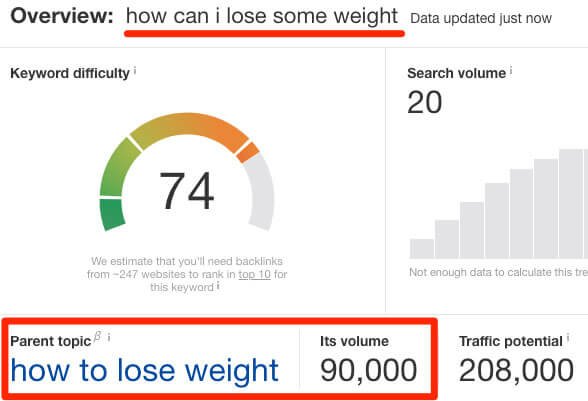
If the Parent topic is a more popular keyword, that’s another sign that your keyword is part of a broader topic.
You can dig deeper by checking the Top keyword for each individual top-ranking page. Just scroll down to the SERP overview report in Keywords Explorer.

None of these pages have “how can I lose some weight” as their top keyword, which further confirms that this is a supporting long-tail keyword.
Final trick: check the Kw column to see the number of keywords each page ranks for.
If most top-ranking pages rank for many keywords, then that keyword must be part of a much broader topic (meaning, the keyword is a less popular way to search for something more popular.)
But how do you get traffic from supporting long-tail keywords like this?
Answer: Target the head directly.
Never target these types of long-tail keywords individually. You’ll waste time because Google views all of them as part of a larger topic.
Here, we have a quick hack to find the top-ranking term online:
- Find one of the top-ranking pages for your long-tail keyword;
- Paste it into Site Explorer;
- Look at the Organic Keyword report;
- Sort by traffic (high to low)
- See which top 3-5 keywords drive the most traffic to the page.

If you can rank for any one of these “head” keywords, you’ll almost certainly be able to rank for hundreds or thousands of other long-tail variations and receive TONS of traffic.
That’s what’s currently happening with the 10 top-ranking pages for the query “how to lose weight.”
But how do you maximize your chances of ranking for as many long-tail variations as possible, to collect as much of this sweet long-tail traffic as possible for the keyword you’re targeting?
The best way is to study the current top 10 ranking pages. See how comprehensive and detailed they are, then make sure your page has as few of those types of keywords as possible.
The second way is to analyze all the keywords that the top-ranking pages also rank for. That will help you create an outline of what should be on your page.
TIP
When choosing between two or more topics with similar search volume, always choose the one whose highest-ranking pages have more traffic.
Let’s look at these two keywords:

Clearly, the query “SEO tips” is a better keyword to target, right? I mean, it has 3 times more search volume, so trying to rank for that would certainly bring the most traffic.
However, not in this case.
Let’s look at the SERP overview report for both keywords.
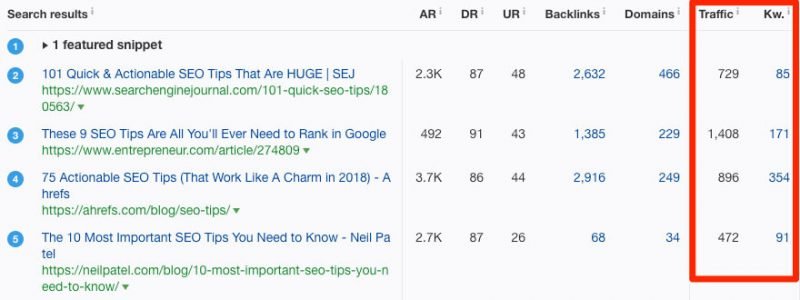
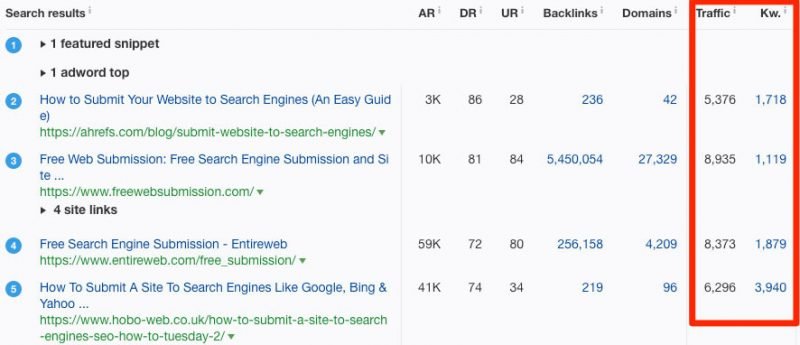
Note that pages ranking for the query “submit website to search engines” can receive 10 times more traffic than ranking for the query “SEO tips,” despite the latter having 3 times more search volume.
So, what’s happening here?
Basically, the query “submit website to search engines” is a broader topic that includes many different long-tail variations.
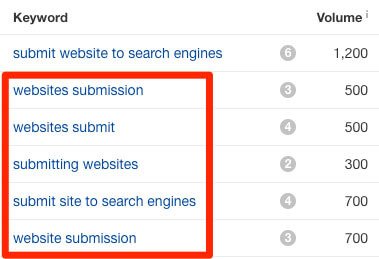
You can see this by checking the Kw column in the SERP Overview section of Keywords Explorer. All top-ranking pages for the query “submit website to search engines” rank for over 1,000 other keywords, while pages ranking for “SEO tips” rank on average for only 100-200 keywords.
Conclusion: “submit website to search engines” is a better topic to target because it has higher search traffic potential.
How to rank for “topical” long-tail keywords
Just to refresh your memory, long-tail keywords are low-volume search queries that are topics in their own right. They’re not part of a broader topic.
Below is an example of a keyword like this:

If we check Google’s top-ranking pages, we can see that all pages are highly focused on this topic. Just look at the titles and you’ll understand.

Furthermore, if we put the keyword into Ahrefs’ Keywords Explorer, we’ll see the same Parent topic.
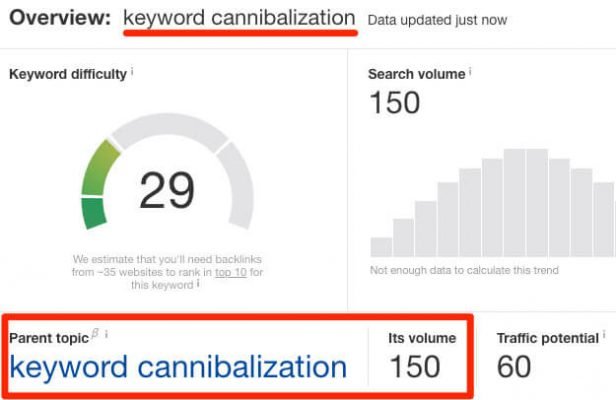
The same thing will happen if we check the Top Keyword for the top-ranking pages in the SERP Overview section.
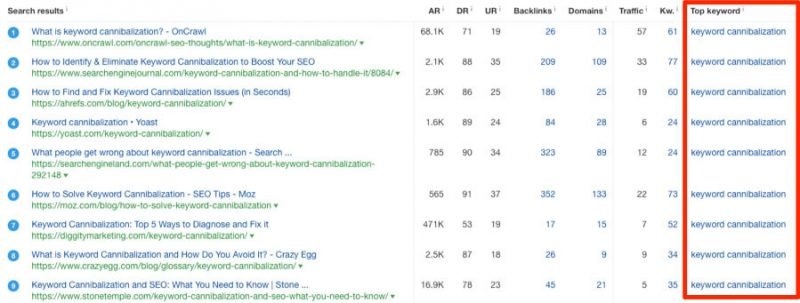
It’s clear then that “keyword cannibalization” is not part of a broader topic. If it were, the top-ranking pages would be focused on more general topics.
So how do you get traffic from long-tail keywords that are topics in their own right?
Answer: Target each topical long-tail keyword with a unique page.
Remember, you can rank for long-tail keywords quite easily. So instead of targeting broad competitive topics like “weight loss” (which is nearly impossible to rank for), you can get tons of traffic from topical long-tail keywords by ranking for 20-50 of them.
For example, you can easily target and rank for all these topical long-tail keywords (with multiple pages)….

….Rather than trying to rank for a single competitive “target” keyword like the query “weight loss.”
But an even smarter strategy to get traffic through VERY long keywords is to use modifiers.
Consider this: if I enter “black shoes” into Ahrefs Keyword Explorer, then go to the Phrase match report and filter search queries containing the word “with”
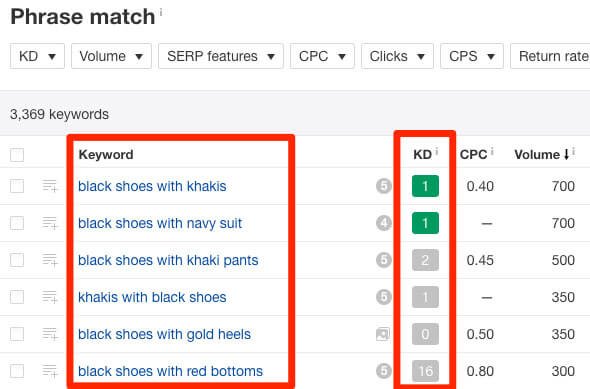
…It shows me over 3000 search queries where people want to learn about different types of clothing.
And as you can tell from the Keyword Difficulty (KD), it’s very easy to rank for those keywords.
So if you have a website about fashion and style, you could create a user-driven Q&A directory and target each topical long-tail keyword with different pages.
You don’t even need to write long, detailed articles about each specific type of clothing. You just need to say if it’s a good or bad idea and show what it actually looks like.
It’s still a lot of work to do, but chances are you’ll work much less than sitting and ranking for head terms in the fashion industry.
Another smart thing SEOs do is attach locations to their product or service keywords and create pages dedicated to each service area.
Let’s search online for the query “rent a truck in” with Ahrefs’ Keywords Explorer and go to the Phrase match report. This time, we get over 400 keywords, all with very long tails.
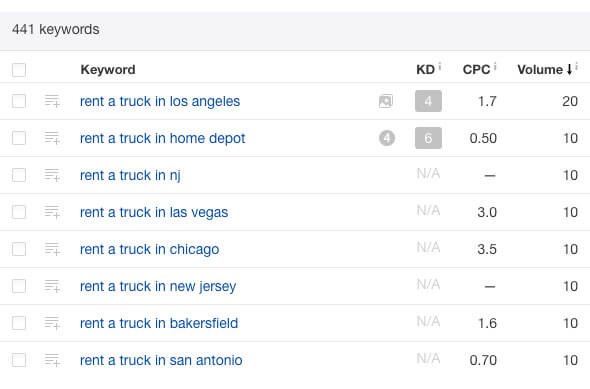
If you think keywords/topics like this have no value due to their low search traffic potential, think again.
Although each of these keywords only gets a fairly low number of clicks per month, remember that you can easily rank for them. Furthermore, you can target hundreds of these keywords with hundreds of different pages.
If you have 300 pages, each targeting a different long-tail variation and each page getting ten clicks per month, that would be 3000 targeted clicks per month (300 pages * 10 clicks).
Plus, although Ahrefs has an industry-leading keyword database, it still doesn’t contain ALL possible search queries that people might use.
So you can safely append ranking positions that Ahrefs doesn’t show search volume for
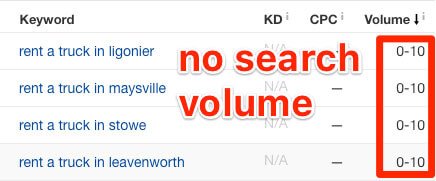
This still means getting a few visits per month for each page you create.
That will eventually add up to a very significant amount of traffic for you.
Of course, you have to do some work to set up a website with this number of pages, but probably much less work than ranking for “head” terms like “truck rental.”
Plus, long-tail keywords are more focused and tend to convert at a higher rate.
Why not all long-tail keywords fit neatly into these two categories (and what to do about it?)
Let’s look at a few of the top-ranking pages for the long-tail keyword “how to name images for SEO” (80 searches/month).

Some results are very broad and talk about image SEO in general, while others focus more narrowly on naming images for SEO.
If we check the top-ranking pages in Ahrefs, here’s what we need to see:
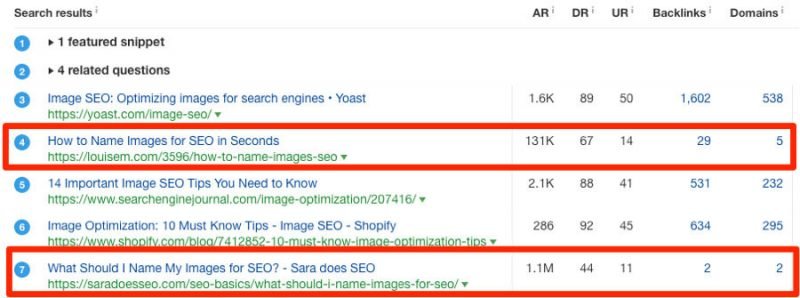
The more focused pages have fewer backlinks and lower “authority.”
So, what’s happening here?
The broadly-ranking pages are in top positions because of their authority. They have backlinks from hundreds of referring domains that allow them to “force” their way into rankings for hundreds of narrower topics.
But Google still ranks some more focused pages for this keyword, meaning there’s still an opportunity to rank. Just treat it like a topical long-tail keyword.
In this case, that means creating content about “how to name images for SEO,” as opposed to the more general topic of “image SEO.” Do that, and you’ve won some ranking factors.
Or you can do the opposite:
That is, write about the broader topic, build tons of links to the page, and watch it rank not only for closely related long-tail keywords but also for somewhat related ones (e.g., “how to make images for SEO“)
You can see an example of this happening with Shopify’s image optimization guide, which ranks for the “head” keyword of the query “image optimization” (800 searches/month) plus nearly 2,900 other similar long-tail keywords:
The route you choose will depend on your answers to these questions:
- Is your website new or does it already have its own authority?
- How valuable are these keywords for your business?
- How good are you at link building?


