

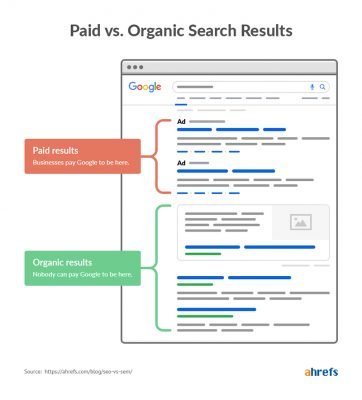
Search engines like Google deliver two types of search results: paid and unpaid.
Paid results appear when companies pay Google for each click.
Unpaid results are what Google considers most relevant to the query.
Business owners can increase website traffic by having their pages appear in paid or unpaid search results using SEO and PPC.
In this guide, we cover when and how to use SEO, PPC, or both for a more comprehensive search engine marketing (SEM) strategy.
But first, you need to look at the basics.
What is SEO?
SEO (Search Engine Optimization) is the practice of optimizing content to be discovered through search engine results.
Google and other search engines consider hundreds of factors to decide which pages will rank for queries. No one knows exactly what all these factors are, but the most important ones are divided into three groups:
On-page SEO
On-page SEO is the method of optimizing individual web pages.
Examples of On-page tactics include:
- Matching search intent
- Covering a topic in depth
- Using short URLs and descriptions
- Writing compelling title tags and meta descriptions
- Using descriptive alt tags for images (when appropriate)
- Writing simple and readable content
- Placing keywords in important locations
Off-page SEO
Off-page SEO is anything done outside a website to improve its search ranking.
Examples of off-page tactics include:
- Acquiring backlinks from relevant and authoritative websites.
- Earning brand mentions.
- Building citations for your page *
- Optimizing your Google My Business listing *
- Getting positive reviews *
SIDENOTE:
Those marked with (*) are primarily important for local business SEO.
Technical SEO
Technical SEO involves making technical changes to help search engines crawl, index, and rank content more effectively.
- Examples of technical optimization include:
- Improving page speed.
- Using canonical tags to prevent duplicate content.
- Using hreflang tags for multilingual content.
- Optimizing robots.txt for more efficient crawling.
- “No-indexing” thin content.
What is PPC?
PPC (Pay Per Click) is a form of advertising where businesses pay for clicks to their website from popular platforms like search engines.
For example: clicking on this ad in Google costs Apple money:
Pages using PPC are often displayed at the top of Google search results
What is SEM?
SEM (Search Engine Marketing) is a term that encompasses both SEO and PPC.
SIDENOTE
Not everyone agrees with this definition. Some people consider SEM synonymous with PPC.
Should you use SEO, PPC, or both?
Learning more about what we need to know about search engine marketing today, it’s easy to conclude that SEO is the way forward that everyone chooses because organic traffic is completely free, consistent, and passive.
This is not always the case.
Sometimes SEO works very well; but other times PPC is a better choice. And sometimes, things work most effectively when you use both marketing strategies at the same time.
Here are four ways to use SEO, PPC, or both to maximize visibility and increase traffic from search engines.
- Run ads for highly competitive keywords.
- Use PPC and SEO for ad-heavy keywords.
- Use SEO for informational keywords.
- Use SEO and PPC to dominate search results.
Run ads for highly competitive keywords
It can take years to rank for some keywords.
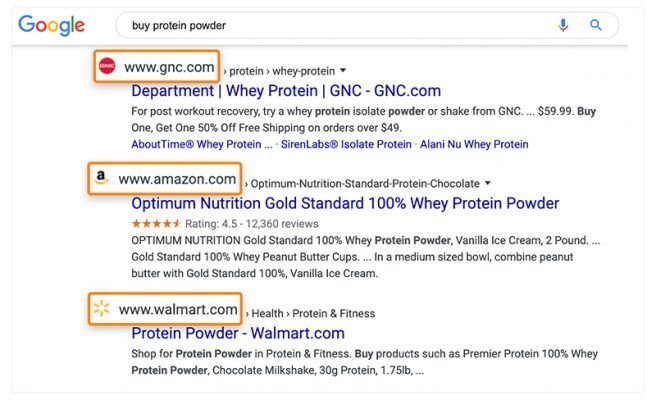
For example: if you have a new store and want to improve your ranking in the “buy protein powder” category, your chances of ranking from low to medium are very slim.
This is because you’re going up against established brands like Amazon, Walmart, and GNC.
But this doesn’t mean you should give up on SEO and just run ads.
Since ranking for highly competitive queries can take a long time, there are some benefits to using PPC while working to improve your page rankings.
You can generate revenue immediately
Paid traffic happens immediately. It can be turned on or off with a single button.
With this support set up on your page, you can start selling within minutes.
Just remember that revenue doesn’t mean you’re making a profit.
If you sell a product for $10, then pay $1 per click with a 20% conversion rate, that means you’re paying twice for that advertising.
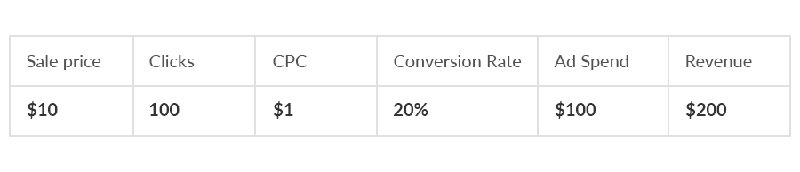
But if your product costs $6 to produce, you’ll probably lose some money!
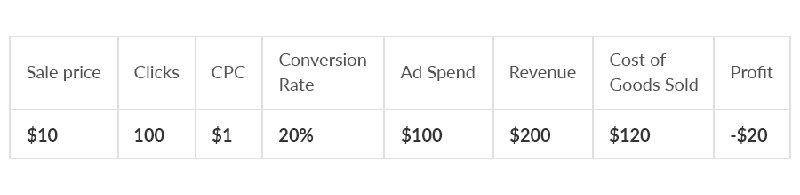
There are two ways to fix this without raising your product price:
- Increase your conversion rate
- Reduce your cost per click (CPC)
Achieving both of these can take several months, so be prepared to lose quite a bit of money while you adjust your campaigns and landing pages.
You can test and optimize for conversions
Most advertising platforms have conversion tracking features. They know that if advertisers see positive results from paying for their ads, they’ll continue to spend money.
Use this as an opportunity to better understand your average cost per conversion and run controlled tests that will improve your conversion rates in business. Once you start making a profit from your ads, expand to other platforms (e.g., Bing ads).
You can get valuable keyword data
Reports in the “Search terms” section of Google Ads will show conversion data for keywords you’re bidding on.
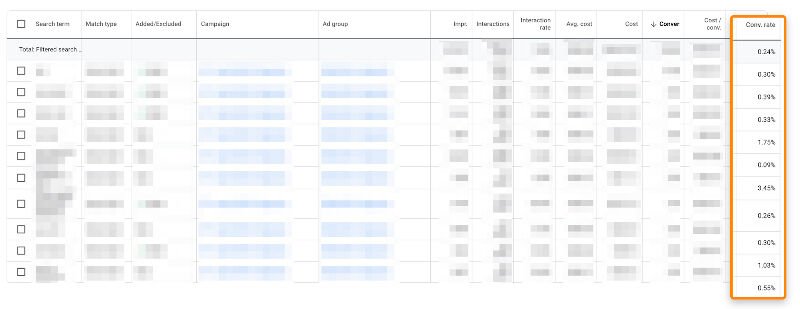
Use these statistics to find high-quality converting keywords to clearly target with your SEO efforts.
For example, let’s say you sell protein powder.
Bidding on a popular keyword like “protein powder” might get you tons of clicks but a low conversion rate. For a more specific query like “grass fed protein powder”, you might get fewer clicks but more conversions.
So, here’s what you can do:
Export a search terms report from Google Ads, filter for profitable terms, then paste them into Ahrefs’ Keywords Explorer to get SEO metrics from them. Next, sort by “Keyword Difficulty” to find what’s easiest to rank for on your website.
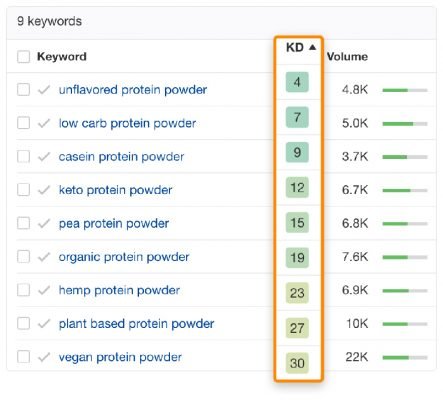
Use PPC and SEO for ad-heavy keywords
Profitable keywords tend to attract more advertisers bidding.
Just look at the results for Belgian car insurance to understand this.
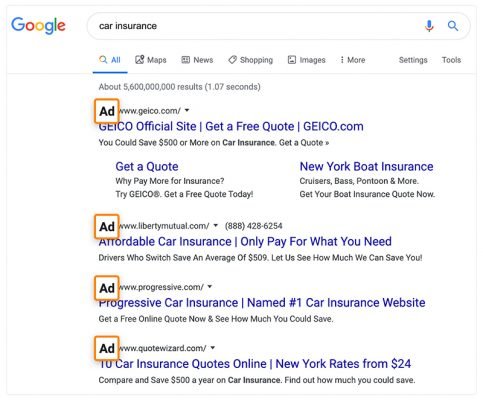
Google displays four paid ads at the top, and that leads to fewer clicks on organic results as they’re pushed to the bottom of the search page.
For that search keyword, nearly 40% will direct users to paid results.
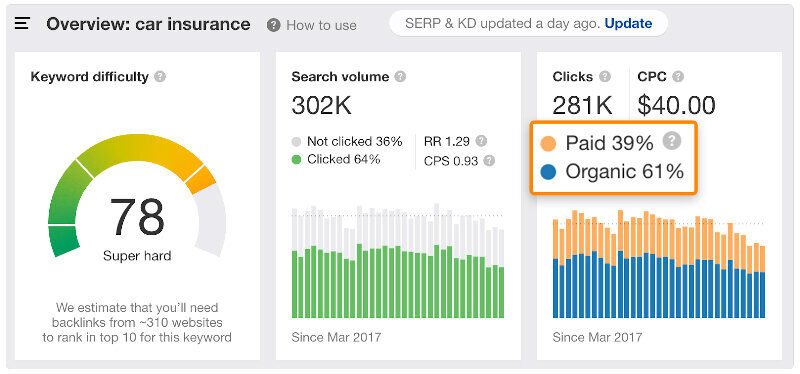
PPC is a great way to get high traffic for this keyword, but what about SEO?
If we look at estimated organic traffic reports versus currently top-ranking pages for this keyword, we see that they get about 64,000 organic visits per month.
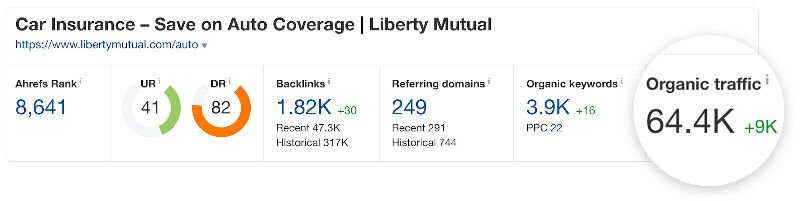
The key point here is to invest in both SEO and PPC for maximum traffic from ad-heavy keywords.
Use SEO for informational keywords
Most searches on Google are informational.
That means people are looking for information, not to buy.
For example: take a query “how to make a protein shake” we see 2,100 searches per month for this topic.
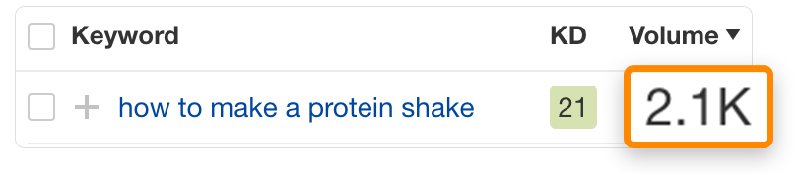
It’s not certain that anyone searching for this query wants to find “protein powder” on the market. Most are probably just trying to learn how to make a delicious protein shake using the powder they already bought.
That explains why no supplement company wants to pay for this keyword. It doesn’t make financial sense, even at a low average CPC.
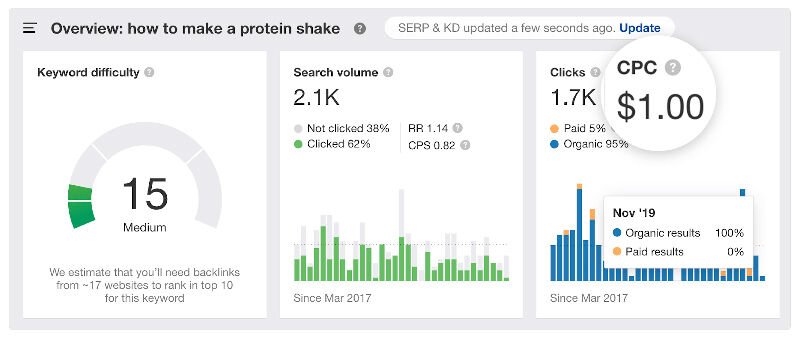
However, when looking at search results, we see a supplement company ranking organically at the bottom of the first page.
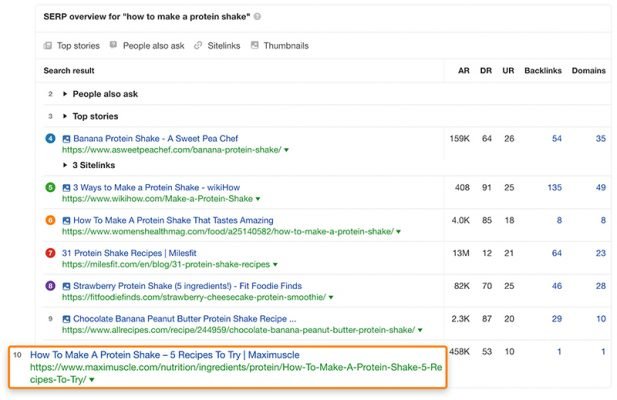
It’s clear from the article title that this wasn’t accidental; they put effort into ranking for this keyword with their article.
The question is, why are they willing to put effort into ranking organically, but not willing to pay for traffic to their page?
The answer is cost and reward.
The top-ranking page for that keyword gets about 9,000 monthly visits. However, the estimated PPC value to get that traffic is $16,400.

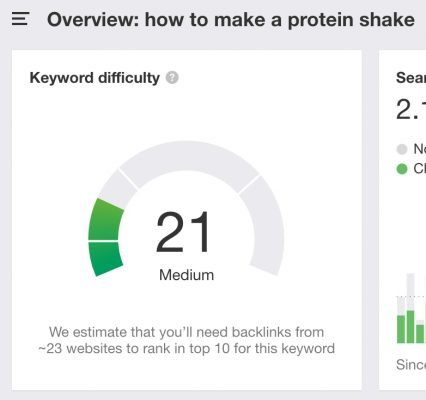
Based on the low “Keyword Difficulty” score for this query, if we assume the money spent is equivalent to the time and effort needed to invest in ranking organically, it’s almost certain that spending your time will cost less than paying to push your page to the top of search results.
Use SEO and PPC to dominate search results
It’s not just that paid pages push unpaid search results down in the rankings.
Google has now started displaying SERP features like featured snippets, “People also Ask” boxes, and video sections for some queries.
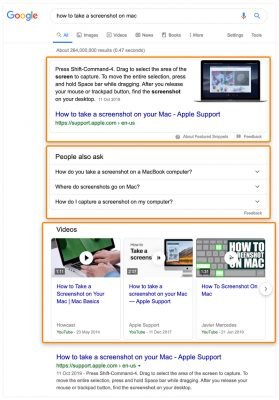
This can be frustrating while you’re trying to achieve the goal of ranking higher on search results pages, but remember that your page still has the ability to appear in SERP features.
Look at the query “how to rank youtube videos”. Our product appeared in the video introduction section, video carousel, and near the top of the “blue link” organic rankings.
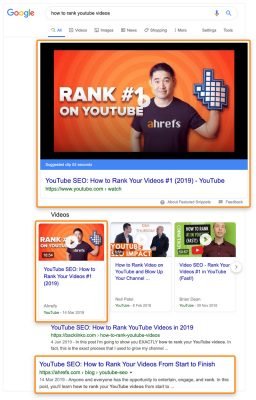
This is true for many SEO-related keywords because we’re committed to providing the best resources for learning SEO. We also try to optimize our videos to rank on Google.
Some brands choose to dominate search results even more by running ads for keywords they already rank for.
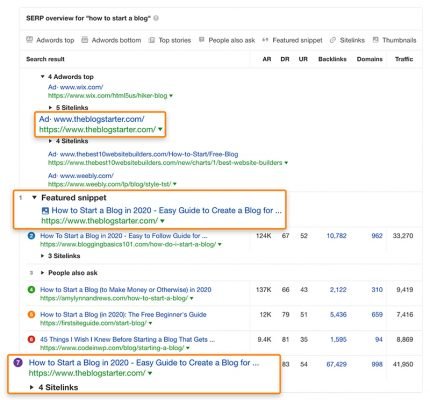
For example: a website runs ads for the article “How to start a blog”, even though this article is already ranking organically and has a position in the featured article suggestions.
Conclusion
Search Engine Marketing (SEM) is not an endless wrestling match between SEO and PPC. Knowing when and where to use each specific tactic to achieve desired results is the game.
Sometimes SEO is the answer, sometimes it’s PPC, and sometimes combining both delivers the best results.


